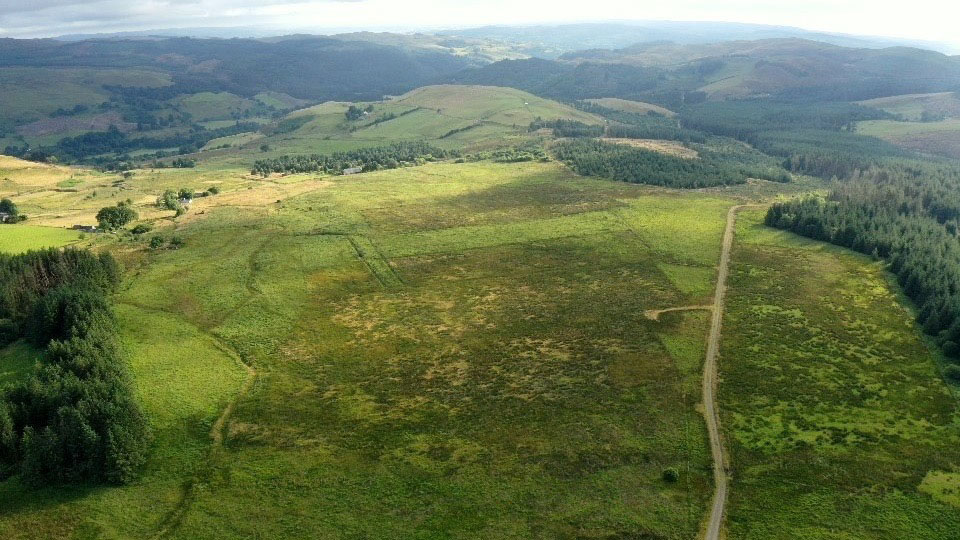
Upland Demonstrator Site 2: Pwllpeiran, Mid Wales
Research team
Jack Cook, Aberystwyth University
Dr Benjamin Roberts, Aberystwyth University
Richard Lindsay, University of East London
Edward Milner, University of East London
Professor Fred Worral, Durham University
Aim
Transition a degraded shallow blanket bog that is dominated by Juncus effusus and Molinia grass into a productive greenhouse gas removal system that sequesters carbon and supports both sustainable land use and biodiversity.
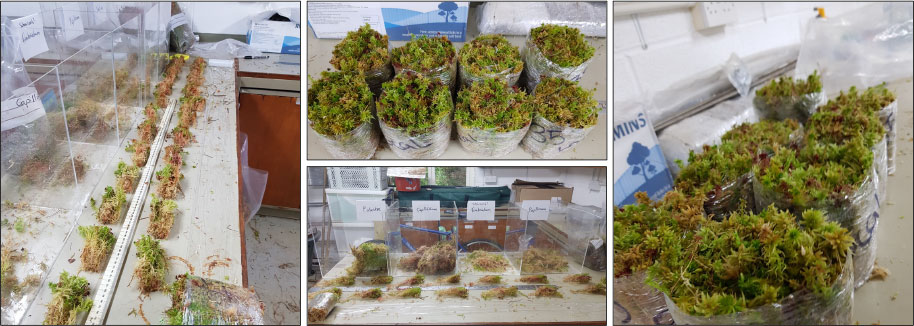
“We sourced Sphagnum plugs growing just 500m away and compared these with mosses grown in a commercial greenhouse. For higher survivability, local mosses perform better and survive longer, while commercially-grown mosses grow a lot quicker.”
Jack Cook
About this site
This shallow, semi-natural peatland lies in the Cambrian Mountains of mid-Wales. Vegetation includes tall grasses such as Molinia and Juncus (rushes), alongside patches of moss and shorter agricultural grasses.
The site has a long history of human impact, shaped by drainage, peat cutting, burning, and later agricultural improvement with fertilisers, reseeding, and grazing. Around 30 years ago, drains were blocked and grazing ceased, leaving the peatland unmanaged since. Peat depths range from 13 to 61 cm (averaging about 44 cm), underlain by a thin mineral layer.
Solutions tested and findings so far:
The project is investigating the survivability of different types of Sphagnum moss and the feasibility of creating biochar on-site from locally cut feedstock. Core samples were collected for a series of mesocosm experiments
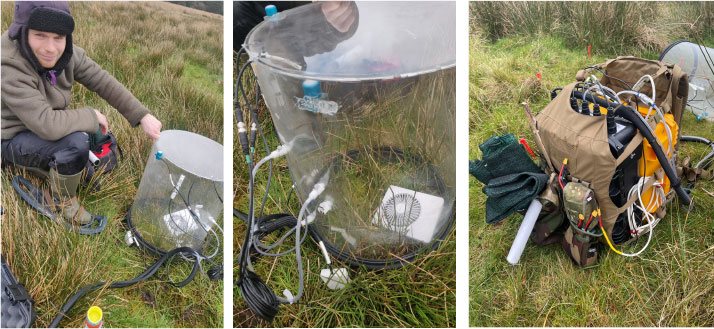
Plot Setup at the Pwllpeiran Field Site
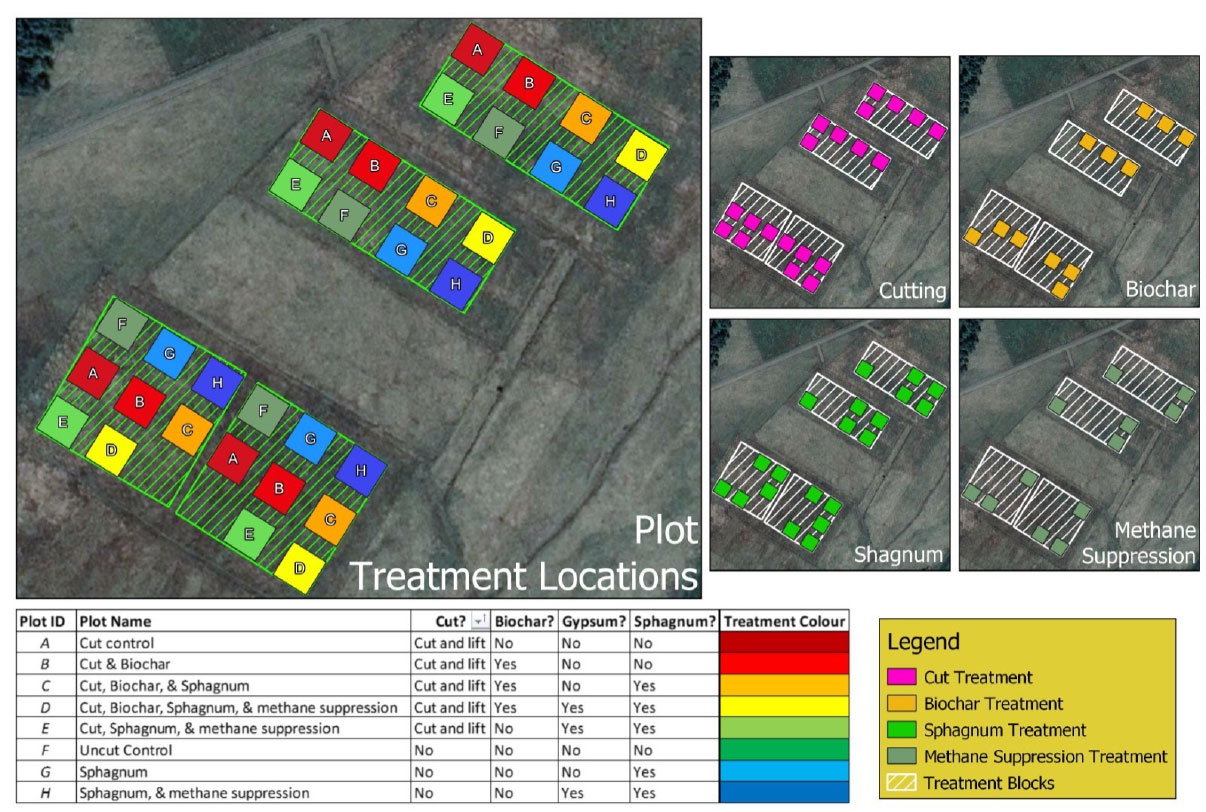
Activity at the Pwllperian Field Site
1. Optimising Sphagnum plug planting
To explore how best to restore degraded blanket bog, over 800 Sphagnum moss plugs were planted on shallow peatland. Two types of plugs were tested: micropropagated (grown in controlled conditions) and locally harvested. They were planted at different spacings and multipliers (the number of plugs combined into each planting unit), with some plots cut to reduce competing vegetation.
Growth and survival were tracked over time, and a statistical model was used to understand how factors such as plug type, spacing, vegetation height, water levels, and cutting treatments influenced outcomes. This approach also accounted for natural variation across the site.
Key findings
- Micropropagated plugs grew faster and larger, especially in cut plots with less competition.
- Locally harvested plugs survived better overall, particularly when spaced more widely and planted directly into peat.
- Moderate spacing (~25 cm) provided the best balance between survival and growth.
- Areas already rich in moss suppressed Sphagnum establishment.
- Targeting suitable microsites, rather than planting in uniform grids, could improve the efficiency of restoration efforts by focusing resources where plugs are most likely to thrive.
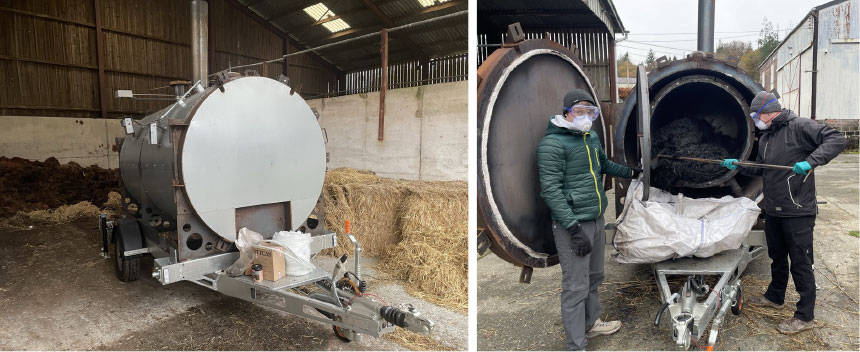
2. Producing biochar from Molinia and Juncus rushes cut on site
Using a Piston Bully mower, the researchers cut excess Molinia and Juncus rushes at a height of 30cm, so the underlying moss was preserved. The cuttings were charred through pyrolysis to create biochar, which was then applied by hand to 1m x 1m plots.
Results
- 2.63 tons of fresh matter were harvested from 1.39 hectares. Cut material had a 24% moisture content.
- 1000kg of Juncus was mixed with 1200kg of woodchip, which yielded 183.6kg of dry biochar. The biochar yield was 5%.
- Cutting vegetation improved the growth of Sphagnum moss.
3. Applying gypsum to suppress methane emissions
Gypsum (calcium sulfate) can encourage sulfate-reducing bacteria to outcompete methane-producing microbes (methanogens). This was tested along with a series of mesocosm experiments to further reduce methane emissions from the peat.
Results
- Early data from emissions testing shows a reduction in methane in treated areas (further analysis pending).
Towards interpretation for peatland restoration
- Site tests and gas emission monitoring showed this peatland was found to be partially recovered and neither a source nor an emitter of greenhouse gas emissions. This shows the importance of closely monitoring sites so restoration efforts can be carefully tailored.
- Trials of different types of biochar feedstock showed that converting mowed grasses to biochar on-site provides yields that are so low that they do not offset the emissions from the cutting machinery used. With grasses regrowing within 1-2 years, there remains the question of whether cutting is worthwhile.
- Commercially grown Sphagnum plugs grew faster and larger, but locally sourced plugs survived better under stress – this highlights a trade-off between growth potential and resilience that should guide which plugs are chosen based on the restoration goals for a peatland.
Why is Molinia grass such a problem for peatlands?
Grazing by farm animals can benefit peatlands by controlling the spread of coarse vegetation and preventing it from outcompeting other plant species. However, changes in agricultural subsidies and other economic pressures have since led to the abandonment of large areas of peatland. When left unmanaged, these lands can become dominated by dense patches of lower-quality grasses such as Molinia, Juncus, and Pteridium. Molinia alone is estimated to cover around 10% of the UK’s uplands. Their mono-specific habitats can blanket large areas of peatland, hindering the growth of mosses and other carbon-sequestering plants, which in turn can impair peat formation.
Publications:
Rewetting alongside biochar and sulphate addition mitigates greenhouse gas emissions and retains carbon in degraded upland peatlands. Peduruhewa H. Jeewani, Robert W. Brown, Chris D. Evans, Jack Cook, Benjamin P. Roberts, Mariecia D. Fraser, David R. Chadwick, Davey L. Jones. Soil Biology & Biochemistry, 207. August 2025. https://doi.org/10.1016/j.soilbio.2025.109814